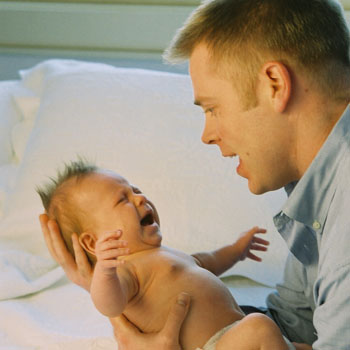

Los bebés comienzan a comunicarse desde que nacen. Llorar, sonreír, vocalizar, mirar su cara y mirar hacia otro lado son todas las formas en que su bebé le dice cuando tiene hambre, sueño, quiere su atención o necesita un pequeño descanso de la emoción. La forma en que respondemos a estos intentos de comunicación ayuda a los bebés a regular sus emociones, manejar el estrés y sentirse seguros. Cuando los padres hablan y escuchan a sus bebés, están creando un vínculo al activar no solo las áreas del cerebro relacionadas con la audición, el habla y el reconocimiento de los sonidos individuales del lenguaje, sino también los centros
Referencias
Dehaene-Lambertz, G., Dehaene, S., Hertz-Pannier, L. (2002). Functional Neuroimaging of Speech Perception in Infants Science 6, Vol. 298. no. 5600, pp. 2013
Gopnik, A., Meltzoff, A. N., & Kuhl, P. K. (1999). The scientist in the crib: Minds, brains, and how children learn. New York: William Morrow.
Kuhl, P. K., & Meltzoff, A. N. (1982). The bimodal perception of speech in infancy. Science, 218, 1138-1141.
Kuhl, P. K., & Meltzoff, A. N. (1996). Infant vocalizations in response to speech: Vocal imitation and developmental change. Journal of the Acoustical Society of America, 100(4), 2425-2438.
Kuhl, P. K., Williams, K. A., Lacerda, F., Stevens, K. N., & Lindbloom, B. (1992). Linguistic experience alters phonetic perception in infants by 6 months of age. Science, 255(5044), 606-608.