
Babbling Appears Less Random; Inflections Apparent (9-14 Months)

Between 8 and 12 months, the coos, gurgles, and other “baby” sounds become more like the sounds of the home language. In English, babies start to make recognizable syllables, like “ba,” “da,” “ga,” and “ma.” Babies may also stumble on words like “mama” and “bye-bye” accidentally, learning more about what they mean when they see […]
Begins to Understand that Words Can Refer to Physical Objects (9-12 Months)

Around 9 months, many infants understand that some words refer to specific objects. Although they can’t yet speak words, many infants will look at things or point at them when they hear certain words mentioned. For example, infants may look or point at a clock when they hear someone mention a clock (or a “tick-tock”). […]
Capable of Uttering “Dada” and “Mama” (8-12 Months)

Between 8 and 12 months, babies may stumble on words like “mama” and “dada” accidentally, learning what they mean when they see the reaction from their caregivers. They may repeat “mama” and “dada” throughout the day to practice uttering the new sounds but will soon begin using these words to attract the attention of their […]
Begins to Use Gestures and Sounds to Communicate (8-11 Months)

By 8 to 10 months, babies attempt to communicate with others using gestures and pre-verbal sounds. There are two common ways children do this: 1) declarative gestures – where the baby points to objects or touches them to get others to pay attention to the item 2) imperative gestures – where infants want something, and […]
Can Respond to Simple Verbal Requests (8-10 Months)

Even though babies often say their first words at around 12 months, most have learned quite a few words by 8 to 10 months. Before they can speak, babies can point to objects when they are named and can often respond to simple directions or requests. References: Shelov, S. P. (Editor-in-Chief). (2004). Caring for Your […]
Learns to Wait until Someone Else Is Finished Talking before Beginning to Speak (7-10 Months)

During their first 6 months, infants will often coo or babble while their caregivers are talking to them. By 7 to 8 months, babies are more likely to show vocal turn-taking: remaining quiet while someone speaks to them and making their own vocal responses when the person finishes. Babies may learn this type of turn-taking […]
Babbling Includes Short Strings of Consonants (6-9 Months)

By 4 months, babies begin listening for the individual sounds in words, noticing how vowels and consonants combine into syllables, words, and sentences. Their babbling often comprises repeated consonant sounds, like “ma-ma-ma” or “ba-ba-ba.” Also, their babbling begins to sound like unintelligible speech that uses the rhythms and characteristics of their native language. Babies often […]
Snuggle Up for Reading (6-24 Months)
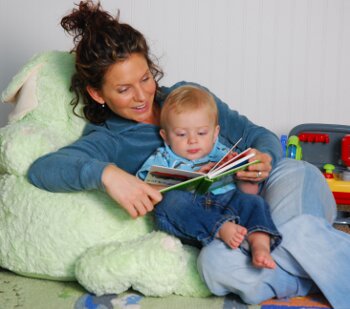
“Mommy! Mommy! Book! Book!” he says before you tuck him in for an afternoon nap. You grab his favorite book, wrap him in your arms and snuggle together for reading time. He helps you turn the pages and proudly finds the mouse hiding in the picture. He giggles for “more!” as you make animal sounds […]
Responds To and Begins To Map Sounds of Language (6-12 Months)

Between 6 and 12 months, babies can literally “hear” the specific sounds of all languages spoken. When compared to adults, babies are better at hearing the differences between the sounds of non-native languages. But by 12 months, babies lose the ability to hear these differences. At the same time, babies improve at distinguishing between the […]
Mommy, Is This Okay? (6-12 Months)

Guiding your baby with your facial expressions and words. Eleven-month-old Cameron can walk, and he can go just about anywhere very quickly. Sometimes his mom even has trouble keeping up with him! Today Cameron sees the corner of the bright red tablecloth hanging off the dining room table. He can’t see what’s on top of […]