
I Want My Mommy

I don’t know you! Scotty is eight months old, and he’s a cheerful and outgoing baby. He always smiles at people and delights in experiencing the world around him. But not today. When his mother brings in a new babysitter, she’s surprised by her child’s reaction. Not only does Scotty fail to smile and respond, […]
Separation Anxiety Increases (10-18 Months)

Around 6 to 8 months, most children begin to show distress when they are away from their primary caregivers. This distress is called separation anxiety and is a normal reaction that tends to get stronger when babies are between 10 to 18 months old. There are different opinions about why separation anxiety occurs, but many […]
Prefers Primary Caregiver above All Others (9-15 Months)

As babies approach their second year of life, they show sustained preferences for the mother and/or regular caregiver above all others. Although they still enjoy the company of other people, children at this age will choose their primary caregivers if they have the option. Babies will seek their primary caregivers for comfort when distressed, for […]
Begins to Look to Others’ Emotions before Acting, Termed “Social Referencing” (9-15 Months)

Starting around 8 to 10 months, children begin to look at the facial expressions of others to help themselves decide what to do. In a way, children can “read” the emotional meaning of another person’s facial expressions. This is called social referencing–looking for emotional clues about a situation in the faces of other people. For […]
Begins to Test Parental Responses to Behavior (8-15 Months)

Babies are intensely curious about parental responses to their behavior. At this young age, babies begin to do things around the home or childcare setting to see what will happen and how others will respond. This is one way that babies learn about cause and effect and what to expect in their interactions with objects […]
Becomes Increasingly Shy or Anxious with Strangers (8-13 Months)
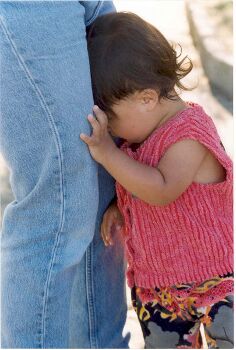
At around 7 to 8 months, most children begin to show fearfulness around unfamiliar people. This is called stranger anxiety and is a normal reaction that tends to increase over the next several months. Children may appear to tense up, cling to their parents, or try to hide from a new person. Many researchers believe […]
Imitates People during Play (8-12 Months)

Although babies are capable of imitating some facial expressions at birth, they become increasingly able to copy adult actions and gestures as they get older. Between 8 and 12 months, babies will imitate a variety of adult (or older sibling) behaviors during play. References: Shelov, S. P. (Editor-in-Chief). (2004). Caring for Your Baby and Young […]
Develops Stronger Preferences for People and Toys (7-12 Months)

Between 8 and 12 months, babies begin displaying stronger preferences for certain people and select their favorite toys, which they focus on and play with for longer periods. They may also protest more vigorously if these toys or objects are taken away from them. Many babies choose a special toy or object (like a blanket) […]
Begins to Show the Emotion of Fear (6-8 Months)

Around 6 to 8 months, most children begin to show fearfulness. Fear develops later than other “basic” emotions because certain steps in cognitive development need to take place first. Before they express fear, children need to be capable of comparing one event (one that causes fearfulness) with some other event they remember. For example, fear […]
Becomes Interested in Mirror Images (5-7 Months)

Visual awareness increases during months 4 through 7, and babies begin to notice new aspects of their environment. During this time, mirrors become a source of fascination for most babies. Most babies will be interested in the reflected images that result when they move their legs or reach for things. They are beginning to connect mirror […]