
Begins Lip Reading (2-8 Months)

When infants are spoken to, they will often pay special attention to a person’s lip movements. Even at 10 to 16 weeks, infants can match certain lip movements to the sounds they are hearing. In one experiment, infants heard recordings of nursery rhymes while watching adult faces on a screen. In some cases, the lip […]
Careful, Frank: Communicating through Emotional Expressions (2-24 Months)

As adults, we do this all the time to obtain feedback from the world around us, but it’s fascinating to learn how early this skill develops. In fact, by watching adults’ facial expressions and listening to their tone of voice, babies as young as 10 months old can use emotional information to decide what to […]
Begins Grouping Language Sounds into Specific Categories (1-6 Months)

Long before babies begin to learn specific words, they engage in an important sound-sorting process that enables them to distinguish the sounds they hear in words. For example, by 6 months, most babies can categorize vowel sounds, such as the difference between “ee” and “ah.” This understanding is one of the essential first steps in […]
Coos Back and Forth with Caregiver (1-4 Months)

In their first months, most babies begin to make cooing sounds. Some believe infants at this age begin to participate in a “conversation” with parents and caregivers. These early “conversations” primarily consist of cooing sounds back and forth, usually after a feeding or when an infant is contented. These “conversations” may form the basis for […]
Attempts to Imitate Some Sounds (1-4 Months)

After 2 months, some infants begin repeating a few of the exaggerated vowel sounds they hear when their caregivers speak “Parentese” with them. These sounds are usually vowel sounds (ooh, oh, or aah sounds, for example). As infants imitate sounds in response to their caregivers, they also begin to learn some basic rules of conversation, […]
Babbling Commences (1-3 Months)

Many infants begin babbling routinely at around 4 months, often entertaining themselves for long periods by producing new sounds (for example, “muh-muh” or “bah-bah”). Although babbling may begin at this age, many normally developing infants begin babbling in later months. References: Shelov, S. P. (Editor-in-Chief). (2004). Caring for Your Baby and Young Child: Birth to Age […]
Talking with Infants (0-9 Months)
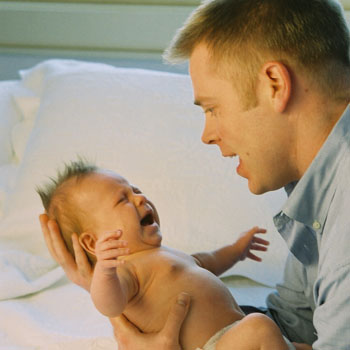
Infants start communicating right from birth. Crying, smiling, vocalizations, looking at your face, and looking away are all ways your baby tells you when they are hungry, sleepy, want your attention, or need a little break from the excitement. How we respond to these communication attempts helps infants to regulate their emotions, manage stress, and feel safe. […]
Smiles at the Sound of a Familiar Voice (0-4 Months)

Babies prefer human voices to other sounds and are especially drawn to the voices of their caregivers. After 1 month, they can identify primary caregivers by voice, even in another room. By the second or third month of life, babies begin smiling in response to the sound of familiar voices. They engage in “smile talk,” […]
Pays More Attention to Human Voices than to Other Sounds (0-4 Months)

At birth, infants show the ability to respond to human voices and speech. In one experiment, infants only a few days old were videotaped as an adult spoke to them. By carefully studying the infants’ small movements and changes in facial expressions, researchers found that infants moved in patterns that corresponded with the human voices […]
Heavy Reliance on Communication through Crying, which Can Occur for Several Hours a Day (0-4 Months)

For the first several months, crying is an infant’s most common form of vocalization. Some cries may sound different from others, and caregivers can learn to “read” cries to some extent. For example, a “pain cry” tends to start with a sudden loud wail. This is followed by a long pause, a large inhalation, and […]