
Realizes that People May Have Different Visual Views of the Same Object (50-58 Months)

Before children are about 4 years old, they don’t understand that their view of an object and someone else’s view of that object might be different. In other words, young children have trouble understanding that people might have different perceptions of the same object. By around age 4, they gain a better understanding of the […]
Shows Increased Sophistication in Understanding the Concept of Time (49-59 Months)

Preschoolers understand that days are divided into mornings, afternoons, and nights and that years consist of four seasons. When they enter kindergarten, children may know some days of the week and understand that time is measured by hours and minutes. References: Shelov, S. P. (Editor-in-Chief). (2004). Caring for Your Baby and Young Child: Birth to […]
Realizes Other People Can Have Inaccurate Perceptions of the World (48-57 Months)

Children gain new insights into how other minds work between ages 4 and 5. Part of this understanding includes realizing people can believe incorrect things about the world. In one experiment, children are shown a closed tube with images of candies and asked to say what is in the tube. Children usually say “sweets” or […]
Becomes Capable of Deliberate Lying (46-53 Months)

When children develop the ability to deceive others is somewhat controversial. Although some researchers believe children can be deceptive by age 3, most believe that deliberate “lying” does not emerge until children are 4 to 5 years old. To lie, a child must attempt to mislead another into believing something false. But several experiments have […]
Begins to Have a Clearer Sense of Time (42-50 Months)

Children develop a much clearer sense of time at about 3 years of age. They know their daily routines and show an interest in learning about the routines of others. Preschoolers understand that certain special events, like birthdays or holidays, occur only periodically, but they have no sense of the length of a year. References: Shelov, S. […]
Learns to Count Objects Accurately (40-49 Months)

Once children begin to talk, counting soon follows. At first, this counting is not very precise, and the words for numbers of things may not match the number of objects counted. By age 3 to 4, verbal counting becomes more accurate. References: Gallistel, C. R., & Gelman, R. (1992). Preverbal and verbal counting and computation. […]
Can Correctly Name Some Colors (40-48 Months)

Although children can distinguish among colors at an earlier age and may learn color words, they may not consistently name the colors they see correctly until age 3 or 4. References: Shelov, S. P. (Editor-in-Chief). (2004). Caring for Your Baby and Young Child: Birth to Age 5. The American Association of Pediatrics. Revised edition. New […]
Capable of Verbal Knowledge of a Few Numbers (39-48 Months)

Preschoolers understand the concept of counting and may know a few numbers by the end of their second year. References: Shelov, S. P. (Editor-in-Chief). (2004). Caring for Your Baby and Young Child: Birth to Age 5. The American Association of Pediatrics. Revised edition. New York: Bantam Books.
Gone Fishing: Understanding that Written Language Carries Meaning
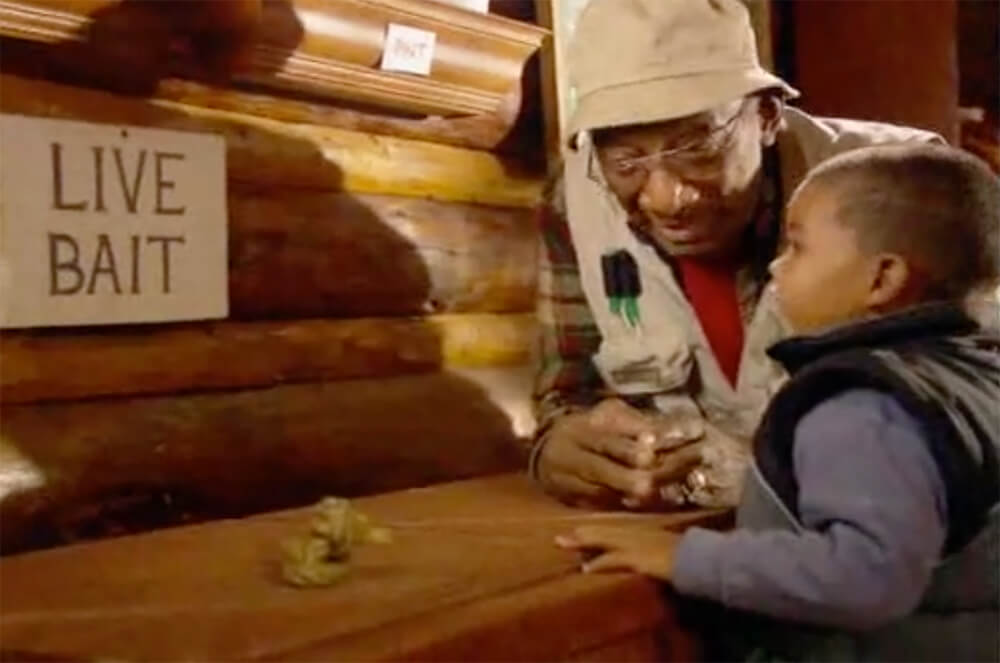
Beginning at an early age, many children begin trying to understand the signs, labels, logos, and printed words they see regularly around them. They are not reading, but they are using their growing knowledge of the world and interaction with adults to give meaning to some of the familiar words they see. Attachments: Tell Me […]
Capable of Approaching Problems from a Single Perspective (38-50 Months)

When faced with specific challenges, three-year-olds approach problems from a single perspective. They haven’t yet developed the ability to see an issue from two angles or to consider multiple aspects of a problem before making a decision. These complex reasoning skills don’t fully develop until around age 7. References: Shelov, S. P. (Editor-in-Chief). (2004). Caring for […]