
Explores the World (4-7 Months)
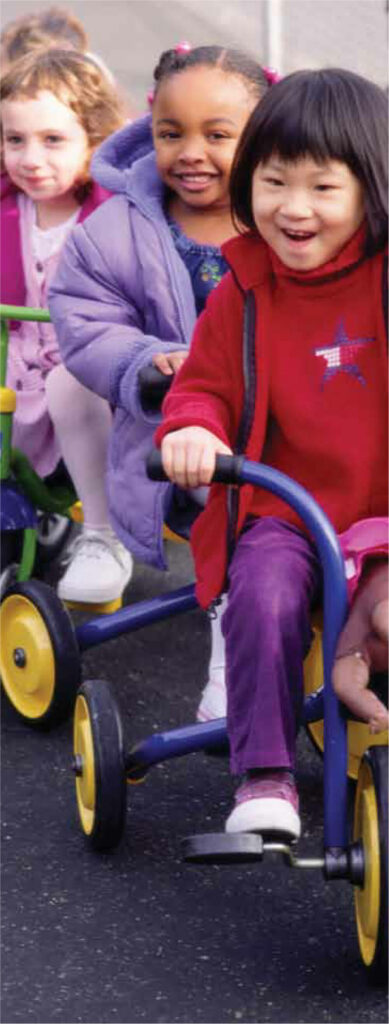
Although newborns react primarily by reflex, babies begin making choices and actively exploring the world around them at 3 to 4 months. Babies this age are capable of bringing interesting objects to their mouths and develop preferences for toys, which they investigate by sucking on them and manipulating them with their hands. Because babies do […]
Struggles To Get Objects That Are Out Of Reach (3-6 Months)

At 4 months, babies begin coordinating their emerging perceptive abilities to struggle to get objects that are out of reach. They use their developing motor skills to grasp items, roll over, or sit up. Babies’ growing curiosity and abilities lead them to try new things, so parents and caregivers should arrange the environment to minimize […]
Cross-Modal Perception: Can Relate What They Hear with What They See (2-4 Months)
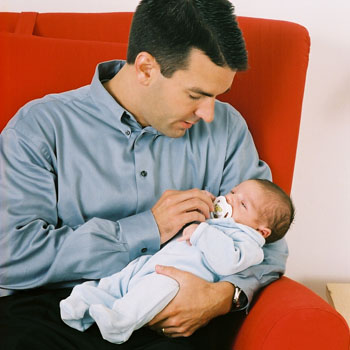
Young infants are also capable of relating what they hear with what they see. One study tested two-month-old infants’ ability to tell the difference between faces that matched sounds that the infants heard and faces that did not match. Infants reliably looked longer at the face that matched the sounds it produced. Even young infants […]
Language Learning Begins (1-6 Months)
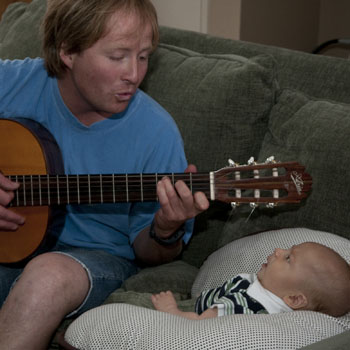
It’s never too early to enjoy a “conversation” with your baby! Neuro-imaging studies show us that long before a baby begins to speak, language learning is taking place in the brain. The neural pathways that are part of the ability to produce language and understand language are activated in an infant’s brain when you speak […]
Cross-Modal Perception: Can Relate What They Feel with What They See (1-4 Months)

For infants to make sense of the sights, sounds, and feelings that buzz around them, they need to coordinate this input and make associations between one sense (e.g., touch) and another (e.g., sight). This ability is called “intermodal matching.” Very young infants are capable of relating what they feel with what they see. In one […]
Capable of Demonstrating Certain Types of Memory (0-7 Months)

All the physical, emotional, and face-to-face experiences that infants have regularly form a network of unconscious expectations and reactions to the world. Researchers call this “implicit memory,” and it is part of brain development, shaping emotion, cognition, and behavior as children grow. Infants don’t “recall” information the same way adults do (called “explicit memory”) because […]
Capable of Making Predictions, Creating and Testing Hypotheses about the Real World (0-6 Months)
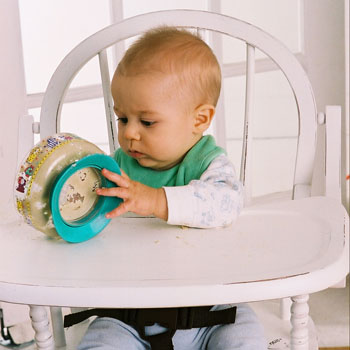
Infants are active learners at birth. They are especially good at using their developing physical skills to interact with the environment in new ways. One powerful way babies learn is by making predictions about how things (and people) work and then testing these ideas. Simple actions like sticking out their tongues at an adult or […]
Recognizes that Objects Remain the Same Size and Shape Even If They Are Distant (0-5 Months)
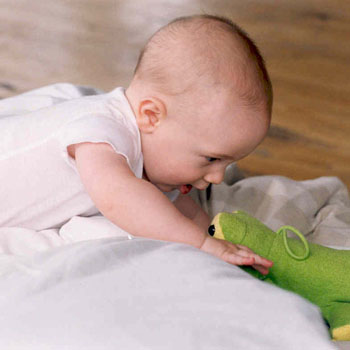
When an object like a ball is moved some distance away, the eye perceives the ball as getting smaller, even though the ball remains the same actual size. Adults know this and recognize that an object is the same despite its smaller appearance. This concept is called “size constancy,” and infants understand this concept at […]
Capable of Mathematical Reasoning: a Quantitative Skill Termed Numerosity (0-3 Months)
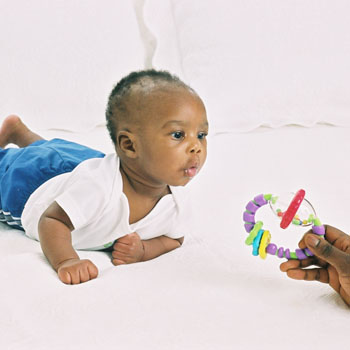
At birth, infants can process some types of mathematical information. More specifically, this ability involves distinguishing between different numbers of objects. For example, most infants can tell the difference between a card displaying three similar objects and a card displaying two of the same objects. Experiments like these have demonstrated that infants have an innate […]
Can Differentiate between Familiar and Unfamiliar Faces (0-3 Months)
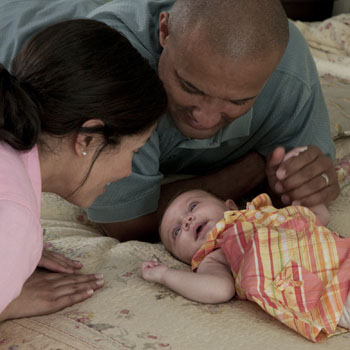
Infants quickly become experts at scanning and identifying faces. A newborn infant can distinguish between its own mother’s face and a stranger’s. By three months, an infant’s vision has improved considerably, and the child is even better at discriminating among faces. Children can tell the difference between a stranger’s face that they have seen only […]